How can we express and begin to integrate experiences that feel too big, too painful or too complex to put into words?
Have you ever found yourself trying to explain how you feel about a situation, but been unable to find the words? Perhaps you have felt stuck in overwhelming emotions of grief, sadness, anger or rage.
Trying to understand difficult experiences by thinking about them, talking them through and searching for explanations can be valuable. But our experiences are not held only in our thoughts.
Emotions are felt in the body
What happens when we stop trying to work things out and allow ourselves to listen differently? What if we gave ourselves permission to express what we feel through movement, sound or stillness, simply following an impulse without needing to know where it might lead?
As the dancer and choreographer Martha Graham once said, “The body says what words cannot.” Sometimes our bodies can express something that we haven’t yet found the words for.
How would it be to give space for movement to arise, rather than trying to perform or choreograph it?
Perhaps the body wants to curl up, stretch, shake, stamp, reach, push away, sway or rock. Maybe a sigh, a cry, a growl or laughter wants to emerge.
When the body holds the story
In The Body Keeps the Score (2014), Dr Bessel van der Kolk explores how overwhelming experiences can continue to affect us through our bodies, emotions and nervous systems, even when we consciously know that an event is in the past.
This helped me understand something about my own experience following the ending of a 15-year relationship. Alongside the immediate loss, I was experiencing a profound disruption to the sense of stability and trust I had felt. The grief and shock seemed almost impossible to process. Gradually, it became clear that what I was experiencing in the present was also touching something much deeper.
Finding expression through Authentic Movement
I remember arriving at my first Authentic Movement (AM) workshop in 2023, carrying this pain. I had spoken to many people and was fully aware that talking therapy was no longer helping me to integrate the experience.
It was a relief to follow the impulses to move, allowing my body to express whatever was present, including through sound. I didn’t need to make sense of any of it during an AM session. All I needed to do was show up, be with the present moment and let my body speak.
There was no music or invitation to move in any particular way. Authentic Movement is about being with whatever shows up. We cultivate the ability to accompany ourselves and to be witnessed by others in an authentic, sometimes raw and uncensored expression of movement and sound.
What emerges is received without analysing, directing or attempting to change what is happening. The witness practises staying present, attending both to the mover and to their own inner experience. This offers an opportunity to be seen and accepted without having to explain, justify or modify what is happening.
Authentic Movement has been explored extensively by practitioners and researchers, including Helen Payne, whose book Authentic Movement for Practitioners: A Culmination of Theory, Research, and Practice (2026) brings together more than three decades of work, research and writing on the discipline.
Our bodies know things that our thinking minds have not yet found a way to express. I didn’t need to find the right words or arrive at an understanding. I could simply allow what was alive in me to be expressed and accompanied.
Photography
An image can communicate something that words cannot. These photographs are from my participation in the SPEX project a theaputic photography project developed by artist Cristina Nunez

This was another experience that became part of my journey towards finding my way back to a more compassionate connection with myself. Through photography, I had an opportunity to explore and express aspects of my inner experience in a different way, discovering things that I might not otherwise have found words for. Can you guess which emotions are being expressed in these images?
Expressing emotions through art and creativity
We might also find expression through poetry, writing, painting, drawing, working with clay or other creative activities. We don’t need to be artists or have a particular outcome in mind.
When we allow colours, shapes, textures and maybe words to emerge without deciding in advance what we are going to create, we can be curious about what reveals itself. Perhaps we want to add something to the picture or model that offers comfort, protection, strength or whatever feels needed.
Drawing
I once supported someone to explore an experience of rage in this way. She began by drawing a swirling red expression of the emotion. As she continued, she found a way to contain it within a goblet. Then, unexpectedly, butterflies began to appear in her picture.
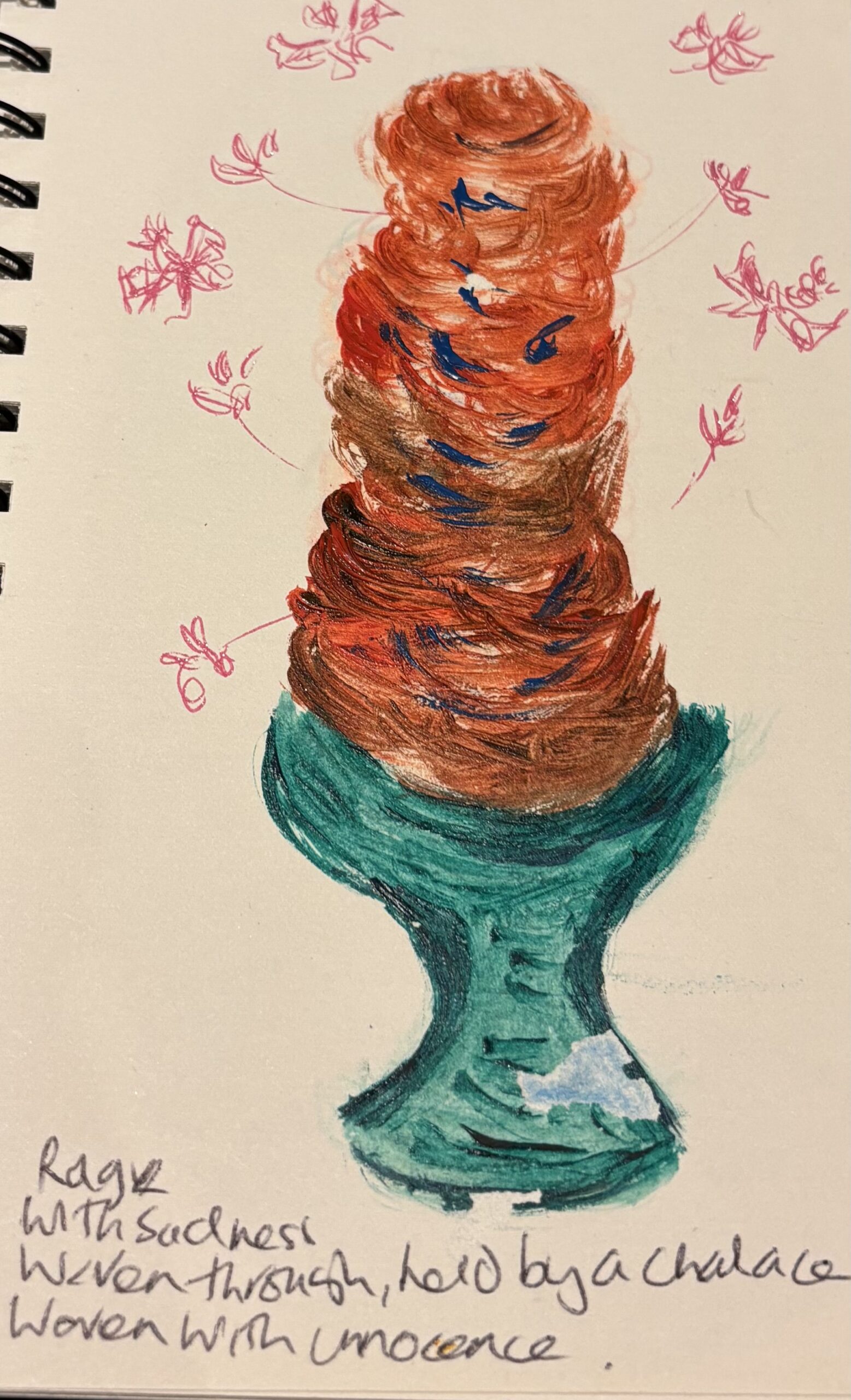 I was curious to witness how the image evolved, without needing to interpret what the goblet or butterflies might mean. What mattered was that she had found a way to express something that had been difficult to hold, and to discover what else might emerge.
This kind of acceptance matters. Accepting what is alive within us can create a greater sense of inner safety and open up the possibility of being in relationship with others without having to hide or modify our experience.
Many of us were not adequately accompanied as children when we experienced the big emotions that are part of being human. Perhaps we were stopped from expressing anger or sadness, or even excitement and joy. We may have been told to calm down, stop crying, be good or not make such a fuss.
Over time, we can learn to suppress, contain or disconnect from parts of ourselves because they were not welcomed or understood by the people around us.
What might become possible if we could begin to welcome those parts of ourselves now? What if we could offer ourselves, and each other, the space and acceptance that may have been missing?
Music and dance
Music and dance offer other mediums through which we can express ourselves, particularly when emotions feel strong or difficult to put into words.
Our bodies contain their own rhythms, not least the beating of our hearts. Music can offer a structure, a pulse or an invitation to move in ways that we might not otherwise discover. Different kinds of music can evoke very different experiences.
Strong bass rhythms can invite us to feel grounded, to connect with our feet on the floor, the pull of gravity and the central axis of our bodies.
Powerful, rhythmic music can inspire staccato movements, punching, stamping, shaking and cutting through the air. Sometimes there is an impulse to push, resist, release or take up more space.
Other music might invite us to be wild, chaotic, playful or uninhibited, offering a sense of freedom and liberation.
Gentler melodies can invite flow, lightness and expansion, as well as tenderness, softness, sadness and tears.
And then there is silence, where we can notice what remains when the music stops.
There is no right or wrong way to move. We might dance energetically, make small movements, lie on the floor or simply allow ourselves to listen. The invitation is to notice what we need and what feels possible.
There are a number of dance and movement approaches that offer spaces for this kind of exploration, including 5Rhythms, Ecstatic Dance, Open Floor and Biodanza. Each has its own particular approach, but all can provide opportunities to connect with ourselves through movement, music and the body.
For some people, dancing alone at home, putting on a piece of music that reflects their mood and allowing themselves to move freely can be a wonderful way of expressing and releasing emotion.
From expression to integration
Expression doesn’t necessarily mean that difficult feelings disappear, or that we immediately feel better.
Through movement, dance, art and speaking, we can begin to give shape to experiences that may previously have felt confusing, overwhelming or difficult to put into words. The process can help us connect with what we are feeling, explore our experiences from different perspectives and gradually find new meaning.
So expression is not simply about releasing emotions. It can be part of a deeper process of understanding and integration, helping us discover what we need and how we might move forward.
Sometimes, allowing something to emerge can leave us feeling more vulnerable. We may need time and space to stay with what has surfaced, notice what has shifted and consider what would support us next.
This is where empathic accompaniment can be particularly important.
The importance of being alongside one another
Sometimes we can find our own way through an experience by moving, creating or expressing ourselves privately. At other times, having another person alongside us makes a profound difference.
That doesn’t mean they need to fully understand our experience, offer advice or find a solution. Often, what makes the greatest difference is simply having someone who can listen deeply, stay with us and accept us just as we are.
In Authentic Movement, the witness practises being present without interpreting or directing the mover. In other forms of creative or embodied work, a facilitator, therapist, coach or trusted companion can also offer a quality of attentive, non-judgemental presence.
Empathy: being present without fixing
This kind of empathic connection can be very different from the well-intentioned responses we often receive when we share something painful: reassurance, explanations, suggestions or attempts to make things better.
Sometimes we don’t need someone to make it better. We need someone who can stay with us while it is difficult.
This is also closely connected to the practice of empathy in Nonviolent Communication (NVC), an approach to listening and speaking with compassion. Rather than immediately offering solutions or trying to change someone’s experience, we can slow down, listen and make space for what is alive in them.
Perhaps this is one of the things we can learn through these different forms of expression and accompaniment: how to stay present with ourselves, even when our experience is difficult, and how to offer that same quality of presence to others.
We don’t always need to find the words, understand everything or make something better. Sometimes it is enough to be with one another, allowing whatever is present to be met with curiosity, compassion and care.
This is the second article in Finding Our Way Back to Connection, a series exploring heartbreak, embodied expression, self-compassion and compassionate communication.
In the next article, I will explore how empathy and compassion can help us meet our own pain and the experiences of others, moving beyond blame towards greater understanding and connection. To read all articles in this series click here
References, books and further reading
- Karkou, V., Oliver, S. and Lycouris, S. (eds.) (2017). The Oxford Handbook of Dance and Wellbeing. Oxford: Oxford University Press.
- Gill, K. (n.d.). SPEX Therapeutic photography {Link)
- Payne, H. (2026). Authentic Movement for Practitioners: A Culmination of Theory, Research, and Practice.
- Pierce, C. and Mahtani, P. (2026). Dance Yourself Happy: Let Biodanza Light Up Your Life.
- Rosenberg, M. B. (2015). Nonviolent Communication: A Language of Life (3rd ed.). PuddleDancer Press.
- Van der Kolk, B. A. (2014). The Body Keeps the Score: Brain, Mind, and Body in the Healing of Trauma.
Exploring this further
If you would like to explore these ways of working more deeply, I offer one-to-one sessions, needs-focused coaching and facilitation, drawing on Nonviolent Communication (NVC), Authentic Movement and Dance.
I also offer workshops and retreats in places of natural beauty, creating opportunities to slow down, reconnect with ourselves and others, and explore the possibilities of embodied expression, empathy and connection.
Leave a Reply